✈️ What does it really mean to be a flight attendant?
It means safety, responsibility… and yes, speaking a language only crew members understand.
Just like doctors, firefighters, or the military, cabin crew members use specific codes and phrases to communicate efficiently and, sometimes, with a bit of humor to survive long days in the air. If you’re thinking of becoming a flight attendant—or you’re just curious—here’s a crash course in the “secret language” of the sky. 🚀
🧩 Key phrases from the Cabin Crew Dictionary
We’ve divided this mini-dictionary into four categories: the essentials, secret phrases, real-time inflight communication, and crew-only humor. Ready to talk like a true cabin crew member?
🔹 Basic Terms
- Galley – The airplane’s kitchen.
- Jumpseat – The foldable seat for cabin crew during takeoff and landing.
- PAX – Short for “passengers”.
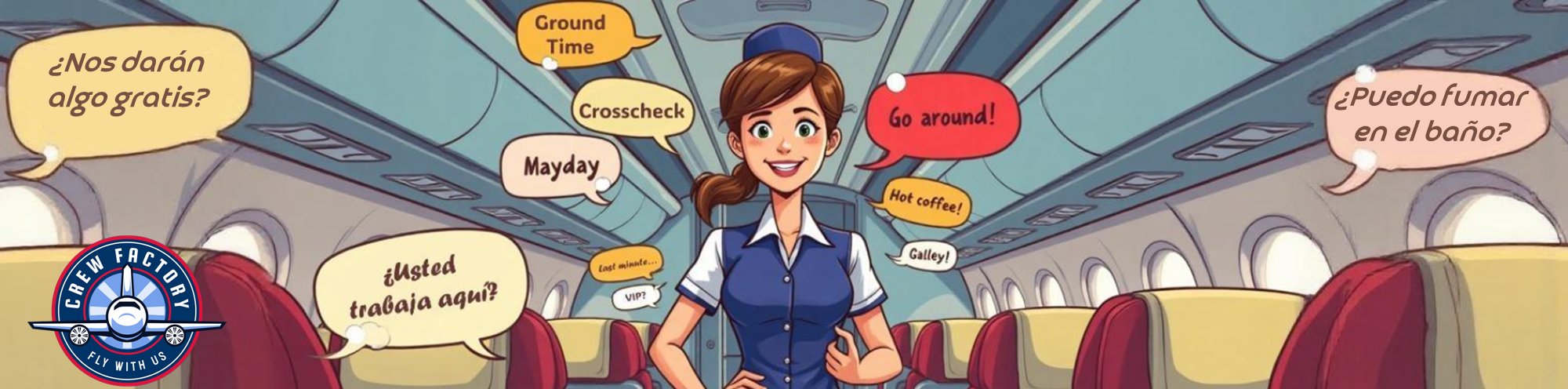
- Crosscheck – A cross-verification between cabin crew members after the doors have been closed and the slides armed.
- Demo – The safety demonstration.
- Trolley – The cart used for service onboard.
- Mayday – The universal emergency distress signal.
- Go Around – When the aircraft aborts landing and circles back.
🕵️♀️ Secret crew phrases
- “SIF” – “Someone important is flying today.” Translation: a company supervisor or VIP is on board.
- “Full full” – The flight is 100% full.
- “Deadhead” – A crew member flying as a passenger, usually to reposition for another flight.
- “Catering not loaded” – Translation: “Prepare for improvisation.”
✈️ Situational slang during flights
- “Do you want to work forward or aft?” – Refers to the front or back sections of the cabin.
- “PA” – Public Announcement.
- “Senior” – The lead or supervising flight attendant on board.
- “The call bells won’t stop!” – Self-explanatory… and very real.
- “We’re delayed for ATC” – Air Traffic Control has paused the flight (again).
😂 Phrases only a crew member would understand
- “Chicken or pasta… again” – The endless onboard meal debate.
- “Who brought the cologne cloud today?” – A passenger might be overperfumed.
- “I’m taking my 10, don’t judge me” – Time for a crew break.
- “Cabin ready” – All checks done, and we’re set for takeoff.
🧠 Final thoughts: Being cabin crew means speaking a second language
Working as a tripulante de cabina (cabin crew) isn’t just about flying—it’s about teamwork, coordination, staying calm, and… speaking in code.
Behind every phrase is a protocol, a reaction time, and a shared experience among professionals who spend their days between time zones, languages, and high-altitude challenges.
📚 Want to learn more about life as a flight attendant?
Here are three articles we recommend if you’re thinking of becoming cabin crew: